Predictive Data in B2B Ordering Platforms
How predictive data turns a B2B ordering platform from a record of what happened into a forecast of what your accounts will do next.
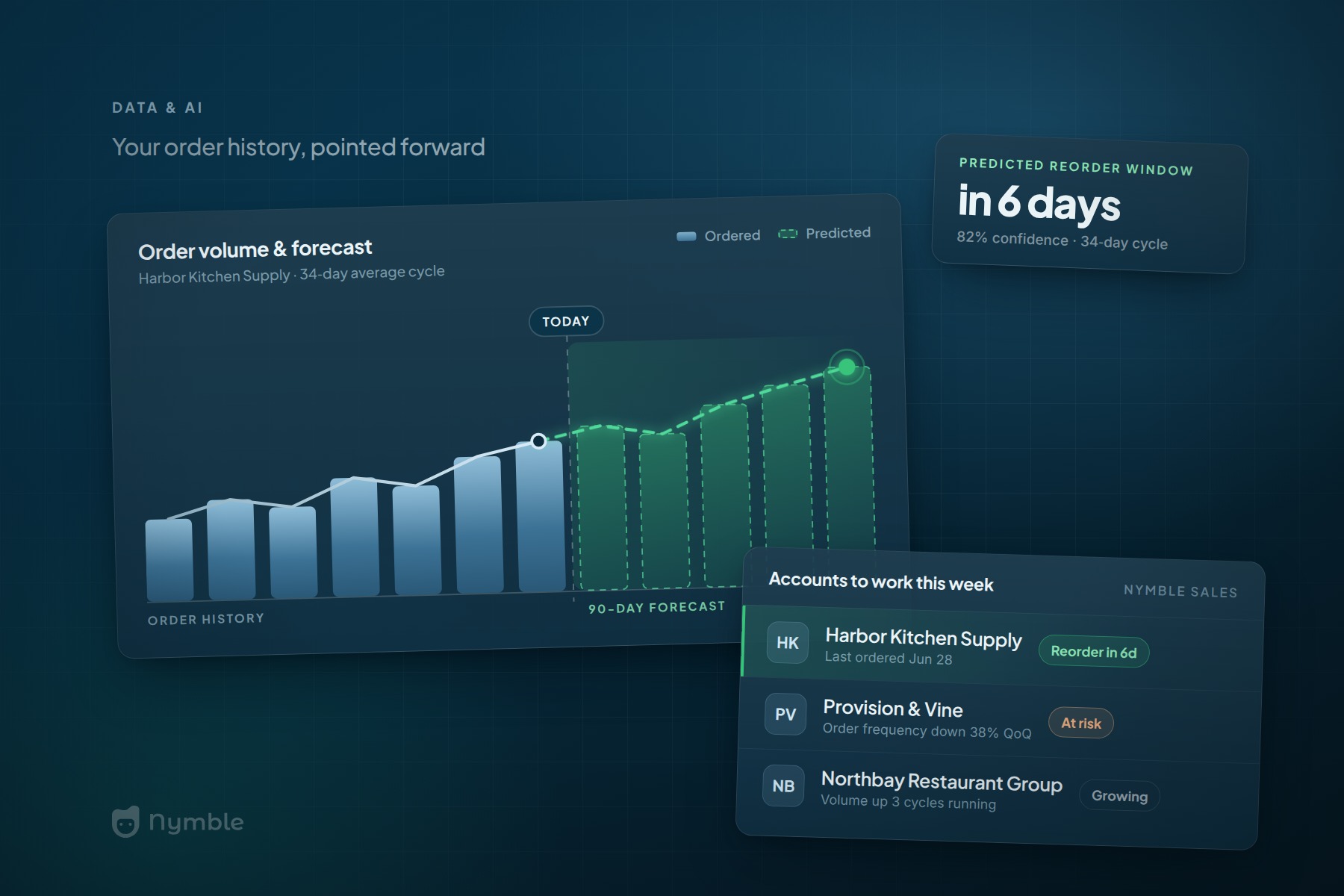
Most B2B ordering platforms are backward-looking. They record what a customer bought and when. Predictive data flips that: instead of a log of what happened, you get a working forecast of what your accounts will do next — which ones are due to reorder, which are quietly slipping away, and where a stockout is about to cost you a sale.
What predictive data actually is
Predictive data reads your own transaction history — order frequency, quantities, seasonal cycles, account behavior — and surfaces patterns a person would need hours to find. The important part: it’s built on your data, not a generic industry benchmark. That’s what makes the signal specific enough to act on.
Where it changes the day-to-day
- Reorder timing. The platform learns each account’s rhythm and flags them as their reorder window approaches — so reps reach out at the right moment instead of waiting for the phone to ring.
- At-risk accounts. A dip in order frequency gets surfaced while you can still do something about it, not after the account has gone quiet.
- Growth opportunities. Accounts with accelerating volume stand out as candidates for a wider product line or a better pricing tier.
- Inventory alignment. Purchasing decisions ground in real buyer patterns, cutting both stockouts and dead stock — which is exactly what built-in demand forecasting is for.
What it looks like in practice
Picture a mid-sized distributor. Instead of chasing accounts weeks after they’ve already gone looking elsewhere, the team opens a dashboard each morning showing which accounts are approaching their reorder window, ranked by order value. Reps spend their time on timely outreach — not manual account reviews.
Predictive data doesn’t replace an experienced rep’s judgment. It points that judgment at the right accounts, at the right time.
How to evaluate it
When a vendor pitches “predictive,” ask four questions: Do the predictions use my data or a benchmark? Do the insights show up inside the daily workflow, or in a report nobody opens? Is the reasoning transparent? And does inventory forecasting actually connect to sales? They’re the same questions worth asking about any AI claim in B2B sales software.
Why it matters more as you grow
A rep with a few dozen accounts can track patterns in their head. A rep with hundreds cannot. Predictive data lets a team carry more accounts without adding headcount — and gives leadership a live read on demand across the whole business.